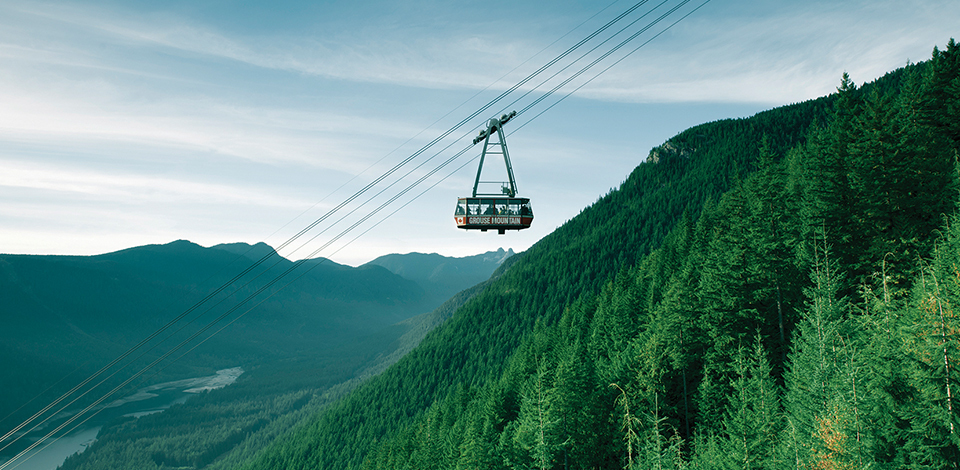
The Gorge Tramways
The vistas of the Columbia River Gorge are known for their panoramic and commanding views. With the building of the Historic Columbia River Highway, viewpoints such as the Women's Forum, Crown Point and Mosier Twin Tunnels, became easily accessible by car. These were signature features of the highway, and people flocked to them. But what about the upper vistas where no road could boldly go? After WW II, four separate attempts were made to access the taller peaks via cable cars, known as tramways. Although each failed, one project came close to harnessing a prized summit with their cable reigns. But in the end, it wasn't too be. Like a wild horse escaping the lasso, Crown point, Benson Plateau and Munra Point refused to be tamed. Native American legend says that the great Klickitat God, Tyhee Saghalie and his two sons, Pahto and Wy'east, watch over these peaks and protect them. The trams have an interesting story.
![Munra Point via George Trail [CLOSED] - Oregon | AllTrails](https://cdn-assets.alltrails.com/uploads/photo/image/19693460/extra_large_f48cb9aa9261601b78ab267012c5c55d.jpg) |
| Munra Point overlooks Bonneville Dam and offers a unique and expansive view of the gorge. Surrounding snow-capped peaks, not ordinarily provided at the roadside, enhance both the view and the experience. |
Tanner Creek Tramway
In October 1947, local businessman Michael R Hanger sought permission to construct an aerial tramway over the Tanner Creek canyon linking Bonneville dam to Munra point (pictured above). The tram was to be 3500 feet long and climb to an elevation of 2100 feet. The lower terminal would have located on Hwy 30 near the dam and the tram would have used 3 cable cars with a passenger capacity of 32 people/car. The upper terminal would consist of a glass-enclosed viewpoint lodge with views of the dam, the gorge and Southern Washington Cascades. Hiking trails would emanate from the lodge to various vantage points and picnic areas overlooking the gorge. Even though the project had the support of the chambers of commerce at Portland, Hood River and the Dalles, it never got off the ground after being rejected by the US Forest Service.
Cost of Tram: $160,000
Round Trip Time: 16 mins
Ticket Fee for Adults: 50 cents
Completion date: 1949
Generally speaking, most of these tramways would have operated on a 7 day weekly schedule for the seven month period of April thru October and weekends and holidays for the 5 month period of November thru March.
With regards to tram construction, no roads would have been built. All construction tasks would have been handled by helicopters and used the working tram to transport men and materials to job sites.
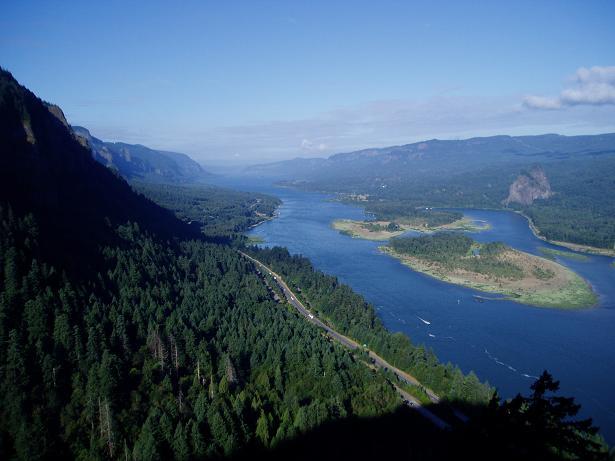 |
The 1964 Forest Service Advisory Study found that the view from Munra Point (seen above) didn't offer a "commanding, expansive view" of the Columbia River Gorge. That finding is debatable. |
The Bonneville Tramway
In July 1963, two Portland businessmen, Lauren Lucas and Richard Britton, began planning a tramway similar to Tanner Creek Tramway. Called the Bonneville Aerial Tramway, plans included a passenger terminal near the Bonneville fish hatchery with a glass chalet atop Munra Point. The chalet would serve coffee and sandwiches to tram-riders. Some trails with several viewing platforms were optional. This was a $500,000 project at the time and used 2 cable cars that would carry 34 passengers to the peak of Munra Point giving them a view to the South of the Three Sisters, Mt Hood and into Eastern Oregon. Views to the north would include Mt Ranier and Mt Adams. Price for the ride would have been about $1.25 for adults. Their plan was to begin issuing stock to the public after the tram received approval from US Forest Service and Oregon State Highway Dept. Their goal was to have the tram completed and running by June 1964. In Jan 1964, the Mt Hood Forest Service decided to take a more in depth look at the feasibility of the gorge tramway at Bonneville.

Sketch above shows Bonneville Aerial Tramway which was to run from a terminal from either I-84 or Hwy US 30 to top of Munra Point (elevation 2100 feet). View would have included Bonneville dam and lower gorge. Munra Point is higher than Crown Point (800 feet) and is inaccessible by road
.

The tramway cars had different prototypes.
This car was designed with large porthole windows and could carry as many as 12 passengers.

In 1963, there were tramways in Germany, France, Austria, Belgium, Poland, Switzerland, Brazil, South Africa and Venezuela that featured different types of cars.

The tramway was incorporating different design features of various trams. Pictured above is the docking station for the Palm Springs tram in Chino Canyon CA.
The Crown Point Tramway
The Crown Point Tramway

One week after the Bonneville Tramway proposal was made public, plans for constructing another tramway from Rooster Rock to Crown Point were announced. The $250,000 project would use a large tower at the edge of Crown Point with passenger cars capable of holding 40 people. The project was to be privately financed. The rationale behind this tram was that after the completion of the water level 4 lane freeway in 1960, the Vista House at Crown Point had become an inconvenient spot to access and was mostly bypassed by tourists. The tramway would eliminate this inconvenience, and upgrade the attractiveness of the vista. The tram would travel 2100 feet to an elevation of 800 feet to Crown Point. Round trips would only be 10 minutes with fares at $1 for adults and .50 cents for kids. Ridership was estimated at 140,000 patrons per year.
In October 1963, the Columbia River Gorge Commission recommended against the Crown Point Tram.
In October 1963, the Columbia River Gorge Commission recommended against the Crown Point Tram.
1964 Forest Service Advisory Study
In April 1964, the US Forest Service began a study to consider not only the Bonneville Tram but all aspects and locations of recreational development in the Columbia Gorge. In February 1965, after one year of evaluation, the Forest Service Advisory Group reached voted 14 to 1 against the Bonneville Tramway project. The group gave the following reasons for voting it down:
1. Extensive site modification was needed at upper terminal.
2. Lower terminal was too small and had space limitations.
3. The views provided were not commanding or expansive.
4. The upper terminal would be too crowded and unsafe.
5. Tram wouldn't blend in and could be seen from highway.
6. The tramway wouldn't meet the revenue projections.
Also, another verdict was reached after the advisory group studied 21 different tramway sites in both Oregon and Washington. The committee explained that they evaluated each site with specific criteria and reached another conclusion: they would never favor a tram at Multnomah Falls and Crown Point.
The Reason: Despoiling Natural Beauty
Some thought this signaled the end for the Bonneville and Crown Point tram proposals, but Lucas and the City of Cascade Locks would make one last big push to bring the tram to fruition.

In 1964, the Forest Service Advisory Group evaluated 21 different sites along the gorge in both Oregon and Washington and reached a conclusion: No Tramway in the Gorge.
Cascade Locks Tramway

In March of 1968, Lauren Lucas, now re-branded as TRAMCO, was back with his final attempt to build his aerial tram in the gorge. This time, the tram base would located in Cascade Locks near the south side of the Bridge of the Gods and travel up to Benson Plateau (elevation 3212 feet) with a total length of 6815 feet. The tram would feature two 35-passenger steel gondolas with a cost of $3.5 million. Views from the upper terminal would have included: Mt Hood, Mt St Helens, Mt Rainier, Mt Adams, Eagle Creek drainage, Rooster Rock, Shell Rock, Bonneville Dam and the Goat Rock Wilderness. A 3-level, rectangular lodge would have been located on Ruckel Creek Spur, a high ridge near Benson Plateau. Lower level of ledge would be for docking, loading passengers, restrooms, seminar meeting rooms and historical/ecological displays. Main level for food, wine, photo supplies, etc and would feature windows for 360 degree viewing. A third level would have been located at the roof allowing open air viewing of surrounding vistas, photo taking with tables for eating. A network of hiking trails would spider out from the lodge. In the winter, the tram could have been used as lift for those wishing to partake in cross country skiing and snow shoeing. New construction of 1 motel, 2 restaurants and several service stations were planned near the lower terminal. It was estimated that the tram would have created 345 new jobs. Hood River and The Dalles were planing new construction of convention centers, motels, restaurants and service stations. This prompted the US Forest Service to carry out another study, this time with public hearings. In March 1969, frustrated by slow progress and the thought of being rejected again, Lauren Lucas abruptly handed over all TRAMCO plans and assets to the City of Cascade Locks to see if they could bring the project to fruition. Lucas then moved to California. It would take the next 4 years for studies, public hearings and an environmental impact report before a decision was made. On Nov 1 1972, the US Forest Service gave its final verdict: APPROVED! After 9 years of imagination, time, energy and money, Lucas' dream he'd handed off was close to being realized. Now, the City of Cascade Locks had to come up with the $3.5 million. The city quickly applied to Economic Development Administration for $2.5M to build the tram. In January 1973, funds were approved, but federal budget cuts under President Nixon reduced funding for the project to $1.2 million. The City of Cascade Locks planned to raise the additional $2.3M by selling revenue bonds. In August 1975, the US Forest Service issued a 30 year permit to build, operate and maintain the tram. With a budget of $3.5M, Cascade Locks invited construction bids for the tram. Emerick Construction Co from Portland was awarded the low bid at $5.1 million. At the same time, environmental groups Mazmas and Sierra Club appealed to the US Forest Service and their cases were dismissed. The Mazamas then filed suit against the Cascade Locks tramways. In December 1975, a Sandy OR couple filed suit for an injunction to stop tram construction. A week later, the Cascade Locks city council rejected Emerick's $5.1 million bid and asked for a cheaper re-design. In October 1976, Oregon Environmental Council filed suit to stop tram. It was dismissed, but they appealed. Then on Dec 1978, the Oregon Court of Appeals ruled in favor of the OEC and against the building of the tram. It was a death blow to the tramway. Under adverse court rulings, pressure from environmental groups and insufficient funds, the city transferred the money to a project to build a stern-wheeler river boat. The Cascade Locks tram would be both the final and closest attempt to ever seeing a tramway in the gorge come to fruition.
Some of the environmental groups opposed to the gorge tram:
Oregon Environmental Council
Columbia Gorge Guardians
Mazamas
Sierra Club
Cost of Tram: $3.5 million
Round Trip Time: 7.5 minutes
Ticket Fee for Adults: $2.50
Completion Date: 1973

In April 1964, the US Forest Service began a study to consider not only the Bonneville Tram but all aspects and locations of recreational development in the Columbia Gorge. In February 1965, after one year of evaluation, the Forest Service Advisory Group reached voted 14 to 1 against the Bonneville Tramway project. The group gave the following reasons for voting it down:
1. Extensive site modification was needed at upper terminal.
2. Lower terminal was too small and had space limitations.
3. The views provided were not commanding or expansive.
4. The upper terminal would be too crowded and unsafe.
5. Tram wouldn't blend in and could be seen from highway.
6. The tramway wouldn't meet the revenue projections.
Also, another verdict was reached after the advisory group studied 21 different tramway sites in both Oregon and Washington. The committee explained that they evaluated each site with specific criteria and reached another conclusion: they would never favor a tram at Multnomah Falls and Crown Point.
The Reason: Despoiling Natural Beauty
Some thought this signaled the end for the Bonneville and Crown Point tram proposals, but Lucas and the City of Cascade Locks would make one last big push to bring the tram to fruition.

In 1964, the Forest Service Advisory Group evaluated 21 different sites along the gorge in both Oregon and Washington and reached a conclusion: No Tramway in the Gorge.
Cascade Locks Tramway

In March of 1968, Lauren Lucas, now re-branded as TRAMCO, was back with his final attempt to build his aerial tram in the gorge. This time, the tram base would located in Cascade Locks near the south side of the Bridge of the Gods and travel up to Benson Plateau (elevation 3212 feet) with a total length of 6815 feet. The tram would feature two 35-passenger steel gondolas with a cost of $3.5 million. Views from the upper terminal would have included: Mt Hood, Mt St Helens, Mt Rainier, Mt Adams, Eagle Creek drainage, Rooster Rock, Shell Rock, Bonneville Dam and the Goat Rock Wilderness. A 3-level, rectangular lodge would have been located on Ruckel Creek Spur, a high ridge near Benson Plateau. Lower level of ledge would be for docking, loading passengers, restrooms, seminar meeting rooms and historical/ecological displays. Main level for food, wine, photo supplies, etc and would feature windows for 360 degree viewing. A third level would have been located at the roof allowing open air viewing of surrounding vistas, photo taking with tables for eating. A network of hiking trails would spider out from the lodge. In the winter, the tram could have been used as lift for those wishing to partake in cross country skiing and snow shoeing. New construction of 1 motel, 2 restaurants and several service stations were planned near the lower terminal. It was estimated that the tram would have created 345 new jobs. Hood River and The Dalles were planing new construction of convention centers, motels, restaurants and service stations. This prompted the US Forest Service to carry out another study, this time with public hearings. In March 1969, frustrated by slow progress and the thought of being rejected again, Lauren Lucas abruptly handed over all TRAMCO plans and assets to the City of Cascade Locks to see if they could bring the project to fruition. Lucas then moved to California. It would take the next 4 years for studies, public hearings and an environmental impact report before a decision was made. On Nov 1 1972, the US Forest Service gave its final verdict: APPROVED! After 9 years of imagination, time, energy and money, Lucas' dream he'd handed off was close to being realized. Now, the City of Cascade Locks had to come up with the $3.5 million. The city quickly applied to Economic Development Administration for $2.5M to build the tram. In January 1973, funds were approved, but federal budget cuts under President Nixon reduced funding for the project to $1.2 million. The City of Cascade Locks planned to raise the additional $2.3M by selling revenue bonds. In August 1975, the US Forest Service issued a 30 year permit to build, operate and maintain the tram. With a budget of $3.5M, Cascade Locks invited construction bids for the tram. Emerick Construction Co from Portland was awarded the low bid at $5.1 million. At the same time, environmental groups Mazmas and Sierra Club appealed to the US Forest Service and their cases were dismissed. The Mazamas then filed suit against the Cascade Locks tramways. In December 1975, a Sandy OR couple filed suit for an injunction to stop tram construction. A week later, the Cascade Locks city council rejected Emerick's $5.1 million bid and asked for a cheaper re-design. In October 1976, Oregon Environmental Council filed suit to stop tram. It was dismissed, but they appealed. Then on Dec 1978, the Oregon Court of Appeals ruled in favor of the OEC and against the building of the tram. It was a death blow to the tramway. Under adverse court rulings, pressure from environmental groups and insufficient funds, the city transferred the money to a project to build a stern-wheeler river boat. The Cascade Locks tram would be both the final and closest attempt to ever seeing a tramway in the gorge come to fruition.
Some of the environmental groups opposed to the gorge tram:
Oregon Environmental Council
Columbia Gorge Guardians
Mazamas
Sierra Club
Cost of Tram: $3.5 million
Round Trip Time: 7.5 minutes
Ticket Fee for Adults: $2.50
Completion Date: 1973
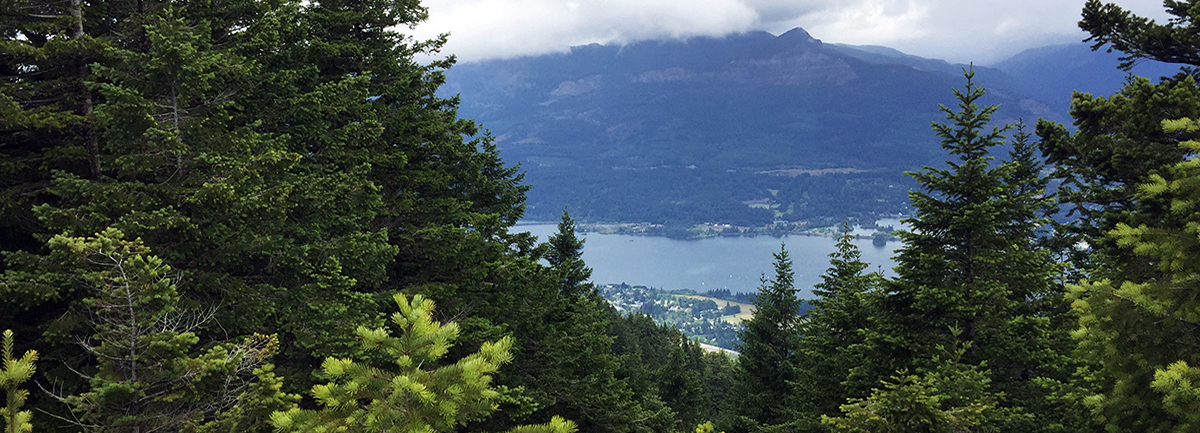 |
View of Washington from Benson Plateau. |

Pictured above is the Sternwheeler at Hood River
From Rodger Nichols: This is the "new" Nichols Boat Works building at the south end of Nichols Basin. The ship being constructed to the east of the building is the sternwheeler Columbia Gorge, built for the Port of Cascade Locks in 1983. Here are Rodger's notes on this ship:
The sternwheeler came about because the port wanted to build a tramway from the river up to the top of the cascades above Cascade Locks. This was long before the Friends of the Gorge, but a number of people were opposed, and the project was killed. Sen. Mark Hatfield, who had already gotten the money appropriated, was able to switch it to a different tourist project for the port, and two and a half million dollars later the sternwheeler became the first on the Columbia in decades. The boat is 147 feet long, 36 feet wide, and the paddle wheel is 17 feet in diameter. It can carry 600 passengers comfortably on its three decks, and it carries the bell from the pride of the sternwheeler fleet based in The Dalles, the legendary Bailey Gatzert, the fastest paddle wheeler on the Columbia (20 miles per hour in 1890.)
The building pictured above was located in Hood River and was removed in 2007
References
Forest Service Advisory Study, 1964
The Oregonian (various articles)
Port of Cascade Locks Aerial Tramway, ES 1972
Historic Hood River Images
Tram Time Line
Tram Time Line
1947 Tanner Creek Tramway proposed and rejected
1963 Bonneville Tramway proposed and rejected
1963 Crown Point Tramway proposed and rejected
1964 US Forest Service Advisory Study
1968 Cascade Locks Tramway proposal submitted
1972 Forest Service Approves Cascade Locks Tram
1973 EDA approves $1.2M for Cascade Locks Tram
1975 US Forest Service approves permit to build tram
1975 Multiple lawsuits filed to stop tram construction
1978 Oregon Court of Appeals rules against tram construction
1979 EDA grants $1.3M to build Cascade Locks sternwheeler
1981 Nichols Boatworks bids $2.9M to build sternwheeler
1982 Cascade Locks signs $2.3M contract with Nichols BW
1982 Construction begins of Columbia River sternwheeler
1983 Columbia River Sternwheeler launched at Hood River
Comments
Post a Comment